We run EntryThingy, an art-call platform for galleries. Artists stay with us because our database of opportunities stays full. From the outside, this looks like our team watching six other platforms for open calls for artists to apply to. But as it works today, we have a scraper, one LLM pass, and one human working a queue.
Every open “call for artists” on the web is a potential entry in our directory. Most calls for art are applications for an arts show, festival, or grant. The more of these we can share, the more opportunities we have to provide our artists with calls they will find useful. And each organization hosting is a prospect.
Before, a single person would hold this entire loop, spending ten hours a week on it: sourcing each of the potential galleries, vetting whether the calls are legitimate or not restricted, and finally getting them in front of artists. Today, we have built a system that is completely autonomous, and requires a human to spend about ten minutes each week verifying that everything is working well.
We start with a list of all platforms we know offer calls, including dozens of local aggregators and off-the-beaten path listings sites. From each call we pull the fields an artist actually needs. All of that information gets sent back to our system, where it gets put into our call for entry format.
Location is important for our artists. Nobody wants to apply to a show, only to find out that it was only available for residents on the other side of the country. Instead of letting an LLM guess, we would have a second agent go and resolve location questions with a confidence interval. For ones where it was highly confident in the location, it got an easy pass. Low and medium confidence calls were checked against what we already knew about the gallery and their previous shows. If a human reviewer was needed, the opportunity was flagged for them to check.
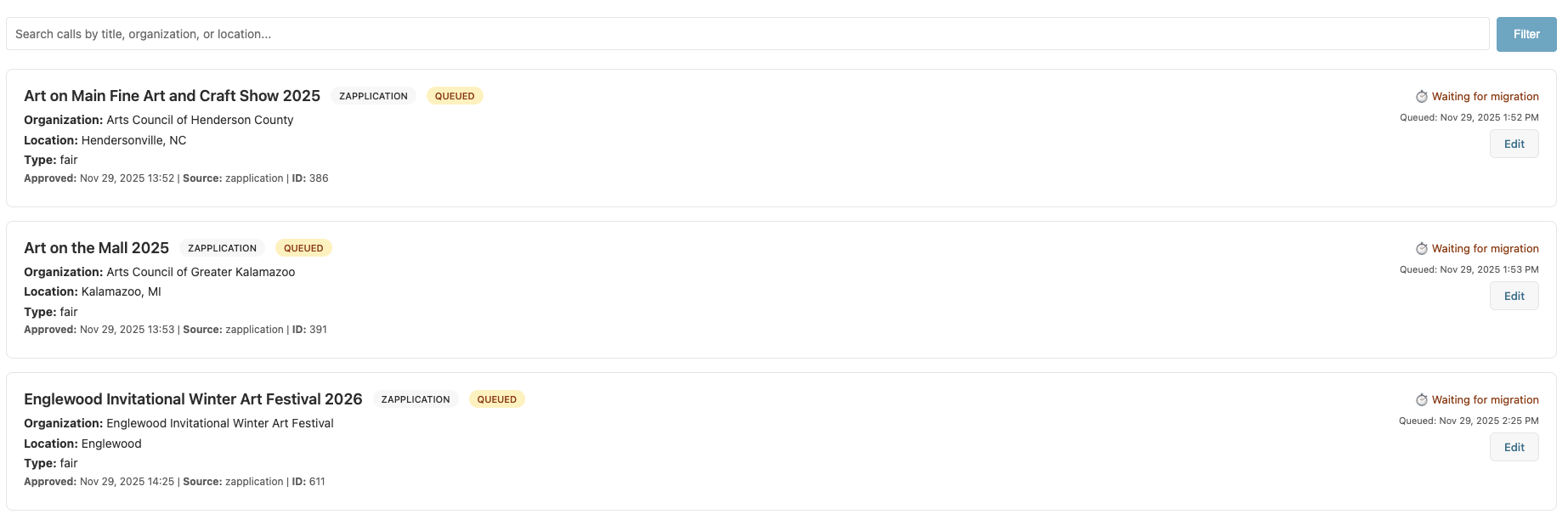
The models here do not write any copy. Instead, it would clean up the text to the core components before being sent off for a review. This leads to a review queue built for humans. Anybody on our team can now go in, and review all of the opportunities for our artists. We have reviewed hundreds of calls in ten minutes after letting the backlog fill for a week.
We keep a human in the loop because we want to make sure somebody will get eyes on the basics of what is going on the platform. Does the grammar and capitalization look correct? Are these opportunities we believe our artists would apply to?
We made the business decision that it was better to send artists off our platform if it meant they found more opportunities with their art. So to do this, we shipped a single pipeline. An extracting agent that provides the correct fields. A one-at-a-time staff review with quick buttons to make decisions. A scraper that hits all the platforms on an hourly basis. A review system to get high quality listings directly on our platform. Now, instead of manually finding leads, this operator can spend the time selling the ones in our pipeline.